
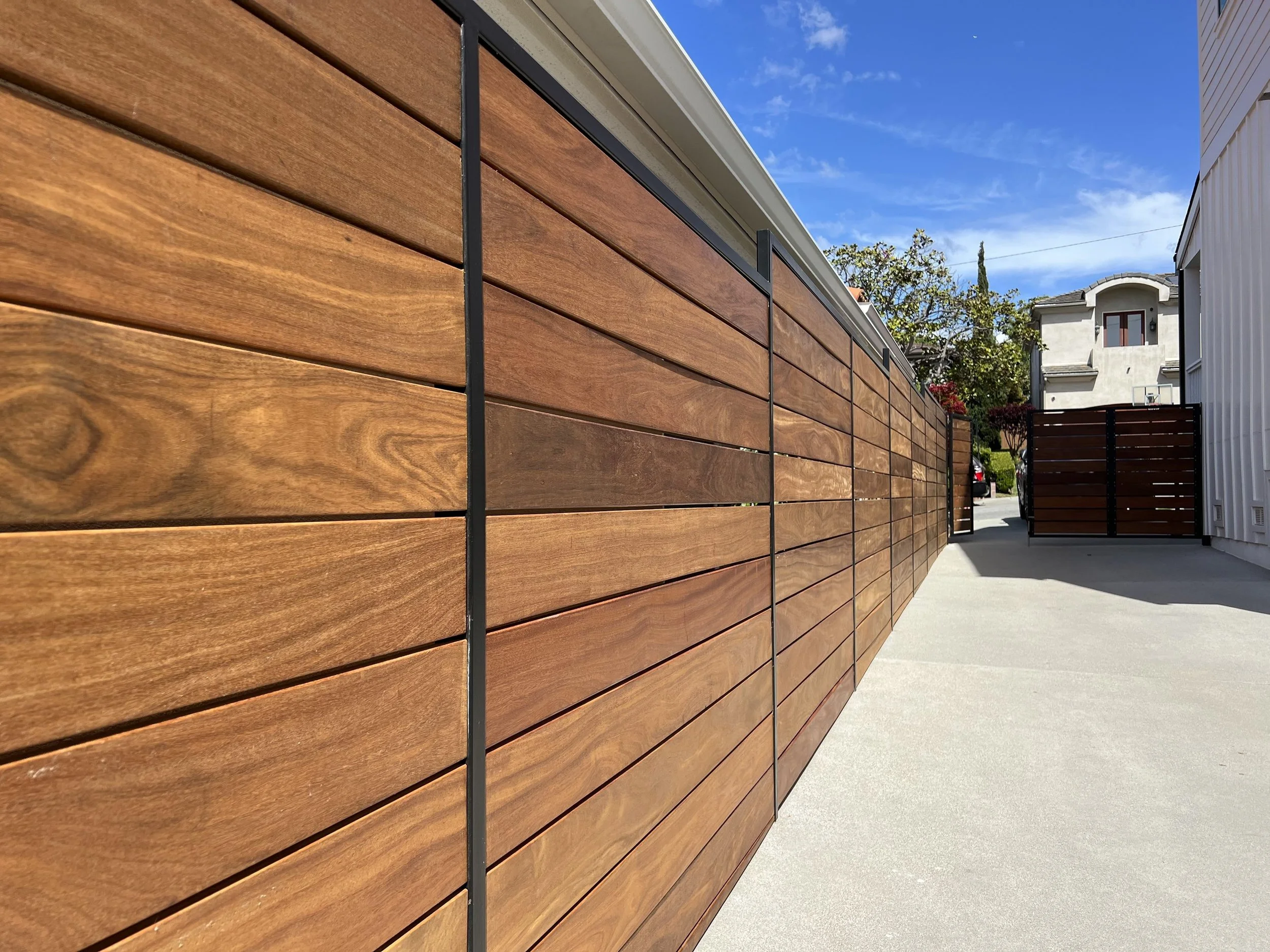
Most wood fences in Los Angeles don't fail from age. They fail from the wrong finish.
We've been called out to hardwood decks that were sealed with a popular penetrating oil just one year earlier, and they already looked worse than bare wood. The homeowner paid for a finish and got 12 months out of it.
Before you spend money on refinishing or on a whole new fence, here's how to tell which one you actually need.
LA Wood Has Two Different Enemies
Where you live changes what's breaking your fence down.
Inland LA: The sun is the problem. UV light dries the wood out, turns it gray, and opens up cracks.
Beach areas (Santa Monica, Venice, Marina del Rey): Moisture is the problem. Salt air and marine layer lead to swelling, mildew, and soft spots.
The right finish depends on which one you're fighting.
The 5-Minute Refinish-or-Replace Test
- Push the posts. If they rock or are rotted at the ground line, refinishing won't fix it. The structure has to be repaired first.
- Poke the bottom of the boards with a screwdriver. If the wood is soft, those boards need to be replaced.
- Check the color. Gray but hard wood is a perfect refinish candidate. The graying is only on the surface and sands off.
- Look for loose boards and popped nails. These are normal and can be repaired as part of a refinish.
- Count the damage. If most of the posts or a large share of the boards are compromised, a new fence usually costs less over time than patching the old one.
What a Real Refinish Includes
Here's how our refinishing process works:
- Consultation. We assess the damage and find where we can save you money.
- Repairs. We fix loose boards, replace rotten wood, and repair the framework underneath if needed.
- Surface prep. We clean and sand the wood, then fill screw holes and nail divots so the surface is smooth.
- Optional upgrades. New top trim can make an old fence look new. One example is a 20-year-old dog-ear fence we refinished with top trim, sanding, and two coats of stain.
- Two coats of stain/sealant. Not one.
Choosing the Right Stain
| Stain type | Look | How long it lasts |
|---|---|---|
| Transparent | Shows the full wood grain | 2–4 years |
| Semi-transparent | Shows some grain, adds color | In between |
| Solid | Covers the grain, even color | 5–7 years |
Closer to the coast, expect a shorter cycle for every stain type.
Our recommendation: Use solid stain if protection is the priority, especially on sun-baked fences. Use transparent or semi-transparent if you want the grain of redwood, mahogany, or Ipe to show, and you're fine with recoating more often.
See our full wood stain guide.
How to Know When Your Fence Needs Attention
Try the water test once a year. Sprinkle water on the wood.
- If it beads up, the finish is still working.
- If it soaks in, the finish is failing. Refinish now, before the wood itself starts breaking down.
Frequently Asked Questions
How often should a wood fence be refinished in Los Angeles?
It depends on the stain. Transparent finishes last 2–4 years and solid stains 5–7 years, depending on sun exposure. Closer to the coast, expect a shorter cycle.
Can a gray, weathered fence be restored?
Yes. Graying is surface-level. Sanding and two coats of stain bring back the color, as long as the wood underneath is still solid.
Is refinishing cheaper than replacing a fence?
Yes, if the posts and most of the boards are sound. If the structure is failing, replacement is the better long-term value.
Do you refinish decks, gates, and pergolas too?
Yes. We refinish fences, decks, railings, gates, and pergolas across LA, Santa Monica, and the Westside.
Does coastal weather change which stain I should use?
Yes. Moisture near the beach wears finishes differently than inland sun. We match the product to your location.
What does the refinishing process include?
It includes an assessment, repairs, cleaning, sanding, filling screw holes and nail divots, and two coats of stain or sealant.